
AI Won't Replace Accounting Firms—But It Will Reshape Them
The real question isn't whether AI takes over tax prep. It's which tasks your firm automates first, and which still need a CPA's judgment.
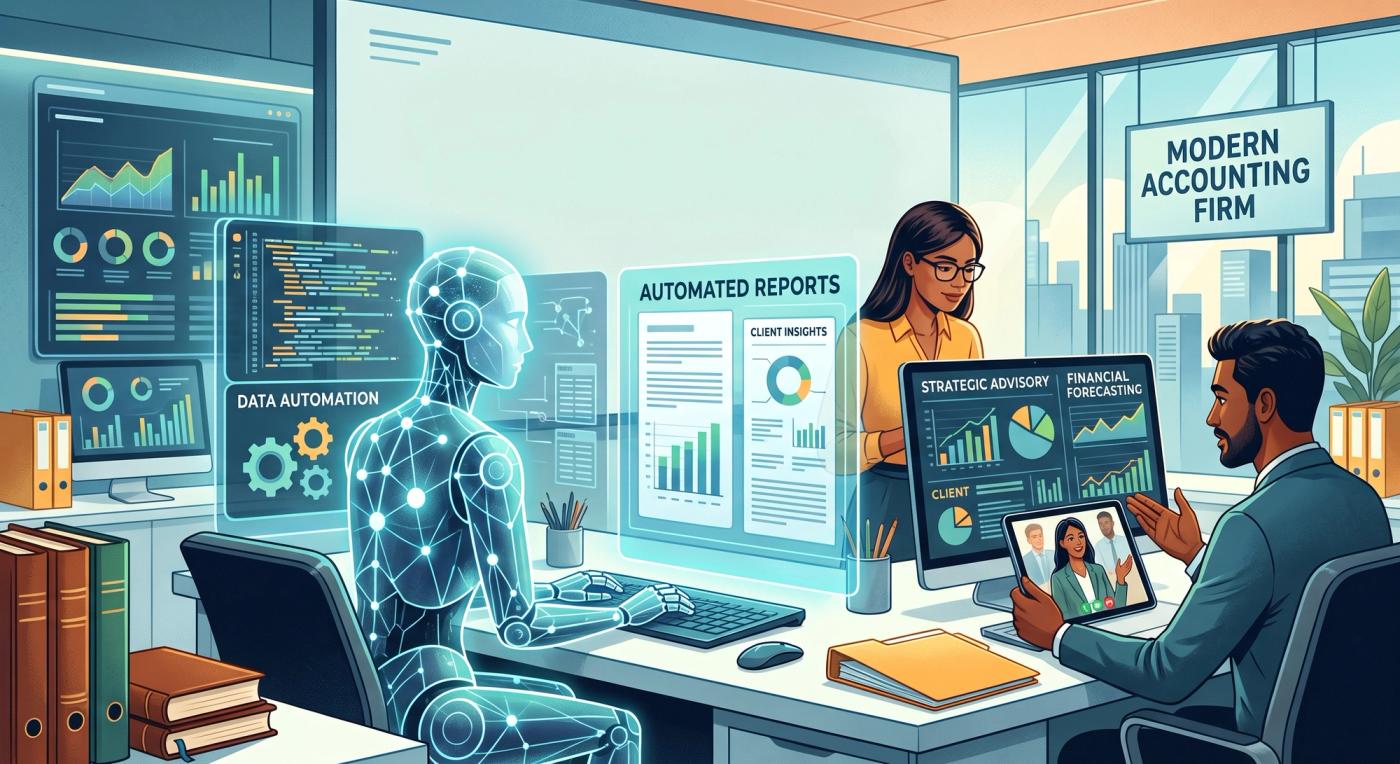
The question surfaces every few years with each new technology wave: will software eliminate the need for accountants? The latest version asks whether AI will replace small-firm accounting practices entirely. The real answer is more useful than either the hype or the panic suggests.
AI automates specific tasks, not entire professions. In accounting, that distinction matters more than in most fields.
What AI actually does in a small accounting firm
The technology handles data entry, bank reconciliation, invoice matching, and compliance checks — the work that fills the hours between client meetings and strategic planning. An AI workflow can log into a client's bank portal, pull transactions, categorize them against historical patterns, and flag anomalies for review. It reconciles vendor statements against AP records. It reads invoices, extracts line items, and routes approvals.
What it does not do: explain to a client why their quarterly estimated tax payment should be higher this year because of a contract structure change. Negotiate an IRS notice. Decide whether a borderline expense qualifies as a business deduction given the client's specific facts and the current state of case law. Build the relationship that makes a client call you before they sign the lease, not after.
For firms with fewer than 10 employees, growth is often stifled not by a lack of ideas, but by a lack of time. A recent 2026 small business study by Xero highlights a painful reality: small business owners and their core team members spend an average of 5 to 10 hours per week just on manual bookkeeping, data entry, and bank reconciliation tasks.
The firms adapting fastest treat AI as a way to protect their staff's time for the work that requires judgment. They automate the reconciliation so the senior accountant can spend an extra hour on tax planning. They let the system handle month-end close steps so the associate can join the client strategy call.
The build-versus-buy-versus-operate decision
Accounting firms face three paths when they decide to automate routine work.
Build means training staff on AI tools, integrating them with existing practice-management software, and maintaining the workflows as client systems change. This works for firms with IT resources and standardized client tech stacks. Most small practices have neither.
Buy means adopting an AI-enabled accounting platform that bundles automation with the general ledger, tax prep, and client portal. The trade-off: you migrate clients onto the vendor's system, which creates switching costs and often requires the client to change how they work.
Operate means hiring a managed service that automates tasks across the systems you and your clients already use — portals, spreadsheets, email inboxes, legacy software. The service designs the workflow, runs it, monitors for errors, and adjusts when a vendor changes their portal layout. Your staff reviews the output and handles exceptions. No migration, no new platform for clients to learn.
...While saving 5 to 10 hours a week on basic data entry sounds great in theory, many small business operations leaders struggle with exactly where to pull the trigger first. [1]According to Jonathan Reeve, Regional Director at Eagle Eye, the answer is simple: target your wallet first. As he noted in a recent 2026 Dynamic Business panel, 'A good starting point is often finance administration, because it is where manual effort most directly costs money.' [1]By focusing on automations like recurring billing and bank reconciliation, micro-firms can cleanly hand off the predictable grunt work to software while keeping human minds focused on higher-level strategic choices. [1]
What changes and what doesn't
Headcount in small accounting firms will likely shift, not shrink. The ratio of bookkeepers to client-facing CPAs changes when reconciliation becomes a review task instead of a data-entry task. Firms hire fewer junior staff for manual work and more for client communication and advisory services.
The firms that struggle will be those that automate nothing and try to compete on price for commodity services AI handles well. The firms that thrive will be those that use automation to deliver faster closes, cleaner books, and more time for the conversations clients actually value.
Client expectations are already moving. A small business that gets real-time dashboards from their payroll vendor will expect the same visibility into their financials. Delivering that without automation means someone stays late reconciling accounts every week. Delivering it with automation means the system does the reconciling and a human explains what the dashboard reveals.
📉 The Staffing Squeeze: Why Small Firms Are Shrinking by NecessityIt is no secret that accounting firms have faced a brutal talent market over the last five years. However, new data shows that small firms are responding not by out-hiring the giants, but by keeping their teams lean and leaning into technology.According to the latest Inside Public Accounting (IPA) National Benchmarking Report, small firms (those under $5 million in revenue) have managed to stabilize their teams remarkably well. In 2025, small firms maintained a staff turnover rate of just 8.1%—nearly half of the 14.6% turnover rate suffered by mega-firms.But staying stable doesn't mean growing. Small firms are operating with flatter headcounts because the pipeline of new accounting talent has completely cratered.🚨 The "Pipeline Problem" by the Numbers:
- The Degree Drop: According to the American Institute of CPAs (AICPA) Trends Report, total accounting program completions dropped 6.6% year-over-year, with Master’s degree completions plummeting by 15%.
- The CPA Collapse: The number of candidates sitting for the global CPA Exam plummeted from over 42,000 down to just 28,082 candidates, choking the hiring pool for boutique practices.
💡 The Pivot to Tech LeverageFaced with a lack of affordable junior staff, smaller practices have completely rewritten their operations playbook. The AICPA National MAP Survey revealed that 81% of smaller firms had to alter their capacity plans due to staffing shortages.Instead of fighting a losing battle for headcount, 40% of these firms shifted downstream tasks directly to automation. Small firms are proving that survival in the modern market isn’t about adding more desks—it’s about optimizing the ones you already have.
The question is not whether AI replaces accounting firms. The question is whether your firm uses AI to do more of the work clients need and less of the work software should have been doing all along.
Canso AgentOps operates intelligent workflows for accounting firms and their clients — automating reconciliation, data entry, and compliance checks across existing systems without requiring platform migrations or staff retraining.