
Care Coordination Starts With Workflow: Why Healthcare Needs Automation
Healthcare was built around specialties. Patients experience it as one journey. The gap between those two realities is a workflow problem—and workflow problems can be automated.
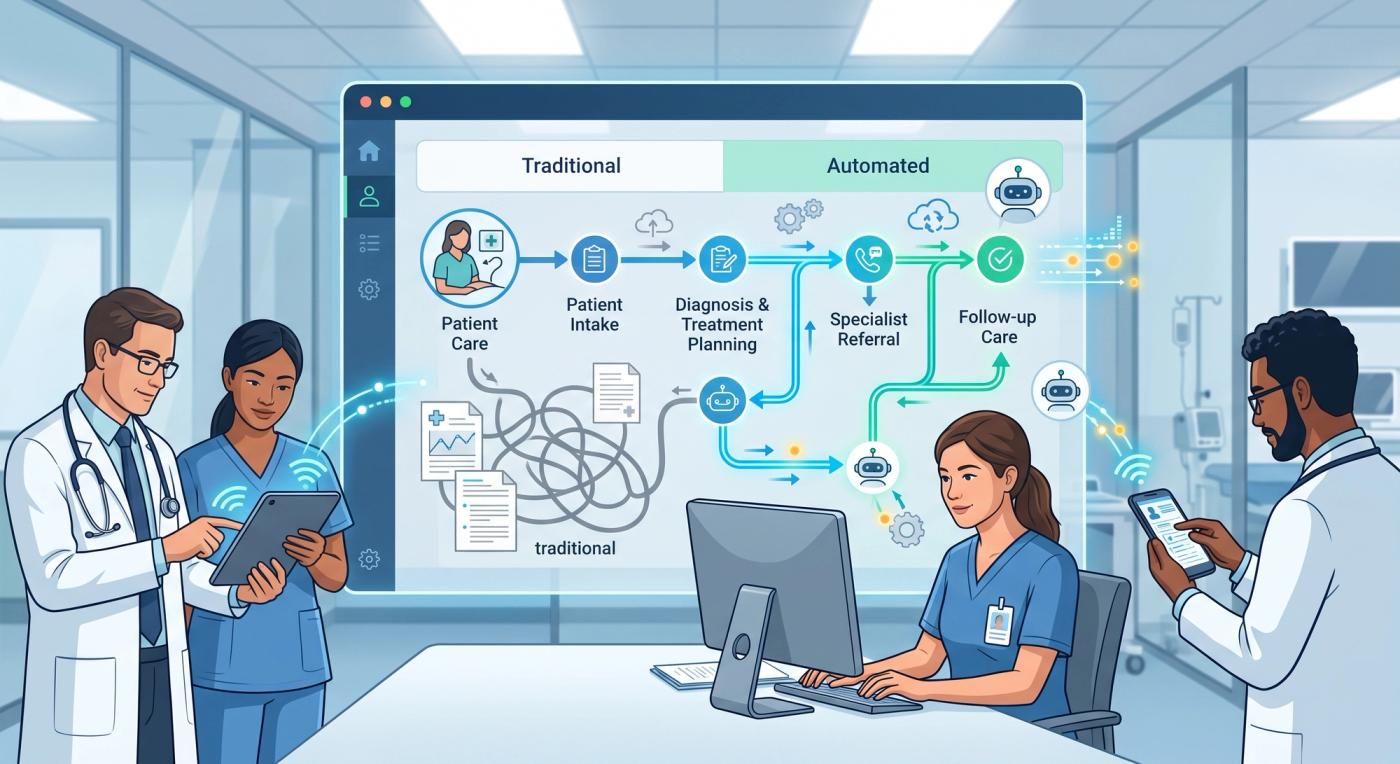
A patient sees their primary care physician on Monday, gets a referral to a specialist on Tuesday, and by Friday is still waiting to hear whether their insurance will cover the appointment. Someone on the care team spent Wednesday morning calling the payer, checking eligibility, and logging into three different portals to confirm prior authorization status. The clinical decision took five minutes. The administrative follow-through took five hours.
Healthcare was built around specialties. Patients experience it as one journey. (Healthcare Dive, 2024) The mismatch creates friction at every handoff: referrals that sit in fax queues, eligibility checks that require manual portal logins for each payer, prior authorizations that ping-pong between systems that do not talk to each other.
Care coordination is the term the industry uses for managing these handoffs. In practice, it means someone on the operations team reconciling data across disconnected systems so the clinical team can do their work.
The coordination tax
Most health systems run multiple electronic health record (EHR) platforms, each payer operates its own portal, and referral networks span dozens of independent practices. The systems were never designed to interoperate. Interoperability standards exist—HL7, FHIR—but adoption is uneven, and even compliant systems rarely share data in real time.
The result is manual work. A care coordinator logs into the payer portal to check eligibility, copies the information into the EHR, emails the specialist's office to confirm the referral was received, and updates the patient's record. Repeat for every referral, every day.
This is not a technology problem in the sense that the systems are broken. The portals work. The EHRs work. The problem is that no one built the connective tissue between them, so humans perform that function manually.
Where automation fits
Automation does not replace care coordinators. It removes the repetitive portal-checking and data-copying that fills their day, freeing them to handle the exceptions and patient interactions that actually require judgment.
An automated workflow can log into a payer portal, retrieve eligibility and prior authorization status, write the result into the EHR, and flag cases that need human review—such as a denial that requires an appeal or a missing document that requires outreach. The care coordinator sees a queue of items that need their attention, not a list of portals to check.
The same approach applies to referral tracking. An agent checks whether the specialist received the referral, confirms the appointment was scheduled, and updates the patient's record. If the referral sits unacknowledged for 48 hours, it escalates to the care team.
What changes
Automation does not eliminate the coordination work. It eliminates the time spent moving information between systems that should already be connected. The care coordinator still manages the patient's journey, still handles the exceptions, still calls the payer when the prior auth denial does not make sense. They just do not spend two hours a day logging into portals to check status.
For patients, the change is invisible but material: referrals get scheduled faster, prior auths get resolved sooner, and fewer appointments get delayed because someone missed a step in the handoff.
For health systems, the change shows up in throughput. [VERIFY: metric on referral processing time improvement or care coordinator capacity increase]
Care coordination will always require human judgment. The clinical handoffs, the patient conversations, the appeals and exceptions—those are not automatable, and they should not be. But the portal checks, the eligibility lookups, the status updates across disconnected systems? That work was never supposed to be manual in the first place.