
Who's in Charge of Your AI Agents? A Governance Reality Check
As agentic AI moves from pilot to production, the oversight question most enterprises haven't answered is suddenly urgent.
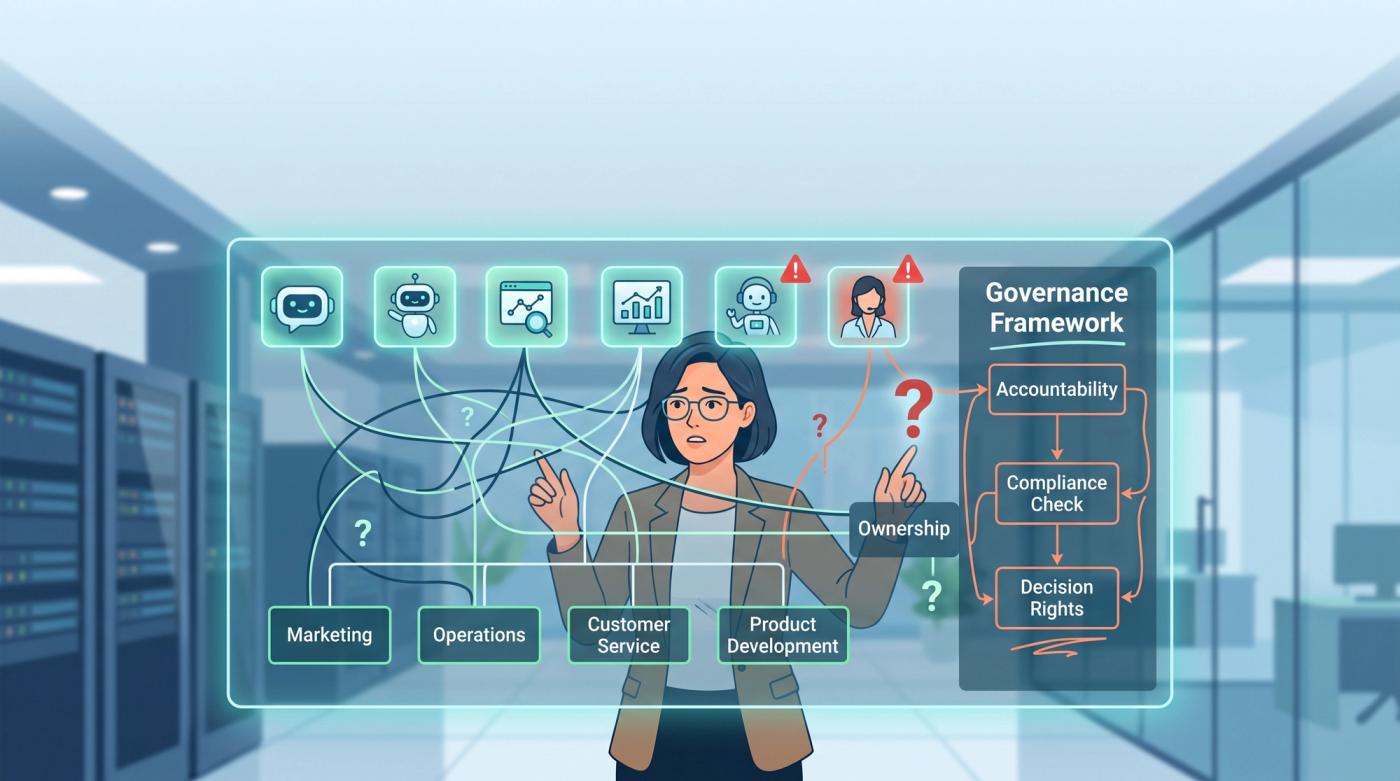
An AI agent logs into your claims portal every morning, pulls status updates for 300 open files, and routes exceptions to the right adjuster. It works. It saves hours. And then someone in compliance asks: who approved the credentials it's using? Who reviews what it did yesterday? Who gets called when it makes a mistake?
The governance gap is no longer theoretical. A recent analysis from RamaOnHealthcare frames the central question bluntly: as AI agents enter the enterprise, who's actually in charge? The technical capability is outpacing the organizational structure to oversee it.
The org chart doesn't have a box for this
In most mid-sized enterprises, IT owns system access and security. Operations owns the workflows. Compliance owns audit trails and regulatory obligations. An AI agent doing real work touches all three domains, and the handoff points are undefined.
The result is ad hoc oversight. One team runs agents in production with IT's blessing but no formal change-control process. Another builds a pilot that compliance discovers three months later during an audit. A third halts a promising automation because no one can agree who signs off on giving an agent write access to financial systems.
What controls actually look like
The enterprises making progress share a few common patterns. They define agent actions as a new category in their access-management and change-control frameworks rather than trying to fit them into "user" or "application" buckets. They log every agent action with enough context that a human reviewer can reconstruct what happened and why. They assign a named owner—usually someone in operations—who is accountable for each agent's behavior and empowered to pause it.
In healthcare, where HIPAA audit requirements are explicit, some organizations treat agent activity logs the same way they treat clinician access logs: reviewed regularly, with anomalies investigated. In finance, month-end close workflows involving agents get the same segregation-of-duties review as manual processes.
The technical side is table stakes: role-based access, encrypted credentials, activity logging, rollback capability. The harder part is the organizational side—deciding who reviews the logs, how often, and what triggers a pause or rollback.
The gaps that remain
Most governance frameworks still assume a human is behind every action. Approval workflows, exception handling, and audit trails are designed around "who did this" rather than "what logic decided this." Adapting those frameworks to agentic AI means rethinking questions like: What does "segregation of duties" mean when an agent performs three steps that would normally require three people? How do you audit a decision the agent made based on patterns it learned rather than rules you wrote?
The regulatory environment hasn't caught up either. HIPAA, SOX, and PCI-DSS all have clear requirements for human access to sensitive data and systems, but the guidance on autonomous agents is thin or nonexistent. Enterprises are writing their own rules, which works until the first audit or incident forces a reckoning.
Starting points
If your organization is running AI agents in production—or planning to—three governance questions need answers now, not later:
Who owns each agent's behavior and has authority to pause it? What gets logged, who reviews those logs, and how often? What access does the agent have, and does that access align with your existing least-privilege and segregation-of-duties policies?
The technology for agentic AI is ready. The governance structures to deploy it safely at scale are still being built, one uncomfortable conversation at a time.